@NASA, July 14, 2023 and July 21, 2023
- Celebrating the Webb Space Telescope’s first year of science …
- Testing remote possibilities of a NASA humanoid robot …
- And a fleet of clean new rides for Artemis astronauts …
- Sending a swarm of small satellites into orbit …
- The first views from our newest storm-watching mission …
- And making the grade for investing in small business … a few of the stories to tell you about – This Week at NASA!
Listen:
-
- mediaBrew Media Player: ( 5 Min. mp3)
- Default Device Player: ( 5 Min. mp3)
Webb Celebrates First Year of Science with New Image
On July 12, we celebrated our James Webb Space Telescope’s first year of science operations with the release of this new Webb image of the Rho Ophiuchi (OH-fee-yoo-kee) cloud complex – the closest star-forming region to us – some 390 light-years away. Since the release of Webb’s first full-color images in July 2022, the telescope has discovered some of the earliest galaxies ever observed, delivered the most detailed views of the atmospheres of planets outside our solar system, and captured new views of planets within our solar system. Learn more at nasa.gov/webb.
NASA Humanoid Robot to Be Tested in Australia
NASA and Western Australia’s Woodside Energy plan to use a NASA Valkyrie robot to test robotic remote operations at the company’s facilities. The collaboration could lead to improved operational safety and efficiency at the company’s offshore and remote installations. The venture could also help NASA develop a remotely operated mobile robot capable of working in conditions not suited for humans – like those astronauts may encounter on future Artemis missions to the Moon.
New Fleet of Vehicles for NASA’s Artemis Crews
On July 11, three specially designed, fully electric, environmentally friendly crew transportation vehicles were delivered to our Kennedy Space Center by Canoo Technologies, Inc. The zero-emission vehicles will be used to transport astronauts from the crew quarters at Kennedy to their rocket and spacecraft at Launch Pad 39B ahead of Artemis missions to the Moon.
Low Altitude Flights Study Everyday Emissions
NASA Armstrong’s DC-8 aircraft is conducting a series of low-altitude flights over some of the most densely populated places in North America, as part of a collaborative effort with NOAA. The project is called AEROMMA – short for Atmospheric Emissions and Reactions Observed from Megacities to Marine Areas. It looks at how urban emissions and atmospheric chemical reactions that stem from the use of everyday items like personal care products and cleaning agents affect air quality and climate.
NASA’s Starling Mission Sends Swarm of Satellites into Orbit
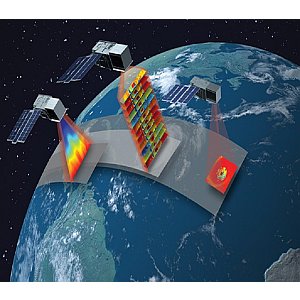
A Rocket Lab Electron rocket launched from New Zealand on July 18 to carry four small satellites to low-Earth orbit for our Starling mission. The cereal box-sized spacecraft will work together as a swarm to see if they can maneuver, communicate, and make decisions on their own, without real-time updates from ground controllers. The mission could help to advance self-coordinating robotic swarms for future science and exploration missions to the Moon, Mars, and deep space.
TROPICS CubeSat Mission Captures First Views of Hurricanes
Our storm-observing TROPICS satellites recently collected the mission’s first views of hurricanes. Late last month, the mission captured imagery data of the first named storms of the Eastern Pacific hurricane season. TROPICS uses a constellation of four identical small satellites to observe tropical cyclones about once an hour – far more frequently than most science satellites. The increased observations could help forecasters and officials better understand and prepare for rapidly evolving storms.
NASA Maintains “A” for Investing in Small Businesses
During a July 18 event at NASA headquarters, the Small Business Administration announced that NASA earned an “A” on the Fiscal Year 2022 Small Business Federal Procurement Scorecard. The scorecard looks at how federal agencies rank on meeting their small business goals. NASA has directly invested $3.6 billion in over 1,700 small businesses across the country, creating good-paying jobs and opportunities for Americans in all 50 states.
Roman Space Telescope Could Find 400 Earth-Mass Rogue Planets
According to new research from NASA and Japan’s Osaka University, rogue planets – which are planets that drift freely through space untethered to a star – far outnumber planets that orbit stars. With so many rogue planets out there, researchers believe that our Nancy Grace Roman Space Telescope could find about 400 rogue planets similar in mass to Earth after the telescope launches in 2027.
That’s what’s up this week @NASA … For more on these and other stories, follow us on the web at nasa.gov/twan.
- The 8th Day – Airs Sundays 6:00a - 7:00a on Marquette County's Sunny 101.9 & online http://8thday.buzz
- The show also Airs Sundays 6:00a - 7:00a on WFXD.com, Fox Sports Marquette 105.1/Gwinn 99.9, GTO.FM 97.5 FM, and WRUP 98.3
- A mediaBrew Communications Community News Partner
- Most content from State and National News is broadcast/posted unedited, without bias or favor to content
- While our show airs speeches (usually unedited), debates, bona fide news interviews or scheduled newscasts, news of local and state and national interest, or an on-the-spot news event, we still welcome alternative points of view, and we encourage those with other points-of-view to write mediaBrew Communications Llc. 3060 US 41 West, Marquette, Michigan 49855 about interviews or similar content we may have previously aired, or to report legitimate news tips.