NASA News – September 16th-30th
- Commemorating an historic event for human spaceflight …
- “We choose to go to the Moon …”
- An update on plans for Artemis I …
- What our Perseverance rover is up to on Mars
- A critical preflight test for Artemis I …
- The first trip to space for a NASA astronaut …
- New Webb Space Telescope images of neighbors in our solar system
- The world’s first-ever planetary defense test is a big hit …
- A major hurricane spotted from space …
- And moving our mega Moon rocket back inside ahead of that storm … a few of the stories to tell you about – This Week at NASA!
Listen:
-
- mediaBrew Media Player: ( 11 Min. mp3)
- Default Device Player: ( 11 Min. mp3)
The 60th Anniversary of JFK’s Speech at Rice University
On Sept. 12, NASA and Rice University commemorated the 60th anniversary of John F. Kennedy’s historic speech at Rice in 1962. In that speech, the President recommitted the nation to the goal he had proposed to Congress in May 1961 of landing astronauts on the Moon before the end of the decade and returning them safely to Earth. As NASA Administrator Bill Nelson pointed out during the keynote address at the event, the President’s speech helped advance our leadership in human spaceflight back then, and it continues to inspire us today as we work to send humans back to the Moon and, eventually to Mars as part of our Artemis program.
“60 years ago, President Kennedy put wind in our sails on the new sea of space exploration and that mission is never-ending. It’s a mission about science and the advancement of the human spirit to expand what is possible.”—Bill Nelson, NASA Administrator
New Target Dates for Critical Artemis I Test and Launch
A cryogenic demonstration test for our uncrewed Artemis I flight test is now targeted for no earlier than Wednesday, Sept. 21. Meanwhile, the agency has requested a Sept. 27 launch opportunity for the Space Launch System, or SLS rocket and Orion spacecraft, with a potential backup opportunity of Oct. 2 under review. During the cryogenic demonstration, teams will load super cold liquid oxygen and liquid hydrogen into the core stage and interim cryogenic propulsion stage of the SLS to confirm that a hydrogen leak has been fixed. Artemis I is the first integrated flight test with the SLS and Orion. The mission will send Orion beyond the Moon and return the spacecraft back to Earth.
Perseverance Rover Investigates Geologically Rich Mars Terrain
NASA’s Perseverance rover is collecting samples and analyzing the composition of rocks at an ancient river delta located in the Red Planet’s Jezero Crater, an area long considered by scientists to be a top prospect for finding signs of possible ancient microscopic life. In its analysis of a sample from a rock named Wildcat Ridge, the rover’s SHERLOC instrument registered the most abundant organic detections on the mission to date. Further conclusions about what is contained in this sample will have to wait until it’s returned to Earth for in-depth study as part of the Mars Sample Return campaign, an international collaboration led by NASA and the European Space Agency.
NASA Announces Pending Departure of Science Associate Administrator
Dr. Thomas Zurbuchen, the associate administrator for our Science Mission Directorate, is planning to leave the agency at the end of 2022. His six years at NASA have included some of the agency’s most inspirational moments, from sending the first spacecraft to touch the Sun, to launching and sharing the first images from the James Webb Space Telescope, to landing the Perseverance rover on Mars along with the Ingenuity helicopter that went on to make the first powered, controlled flight on another planet. The agency is conducting a nationwide search and open competition for a new associate administrator.
Ground Recording Stations Tested for Future Quiet Supersonic Flight
The team at our Armstrong Flight Research Center recently completed a flight series called CarpetDIEM which tested state-of-the-art ground recording stations designed to hear and record the unique sounds that will be generated during future supersonic flights by NASA’s X-59 aircraft. The X-59’s goal is to reduce the intensity of sonic booms, which are heard when an aircraft flies faster than the speed of sound, to a quiet sonic “thump”. When the X-59 flies, NASA will record the sonic thumps as part of the effort to validate its quiet supersonic design.
A Critical Preflight Artemis I Demonstration Test
On Sept. 21, teams at our Kennedy Space Center conducted a cryogenic demonstration test with the Space Launch System, or SLS rocket for our upcoming uncrewed Artemis I flight test around the Moon. The demonstration test was designed to allow teams to confirm the repair of a hydrogen leak that cropped up during a previous launch attempt in early September, evaluate updated procedures for loading the rocket with propellant, and conduct additional evaluations. Keep up with the latest Artemis I updates on NASA’s Artemis blog at: blogs.nasa.gov/artemis.
NASA Astronaut Frank Rubio Launches to the Space Station
Also on Sept. 21, NASA astronaut Frank Rubio launched to the International Space Station from Kazakhstan with two other members of the station’s Expedition 68 crew. Later that same day, they docked to the station’s Rassvet module and were welcomed aboard by the Expedition 67 crew, including NASA’s Bob Hines, Kjell Lindgren, and Jessica Watkins. This is Rubio’s first spaceflight.
Webb Image Captures Clearest View of Neptune’s Rings in Decades
Our Webb Space Telescope’s first image of Neptune includes the clearest view of Neptune’s rings since the images Voyager 2 captured during its 1989 flyby of the distant planet. Webb also captured seven of Neptune’s 14 known moons including Triton, which orbits Neptune in an unusual retrograde, or backward direction. Additional studies by Webb of both Triton and Neptune are planned in the coming year.
Webb’s First Observations of The Red Planet
The Webb Space Telescope recently used its infrared capability to capture its first images and spectra of Mars. Images of the planet’s eastern hemisphere captured by Webb’s Near-Infrared Camera show surface features, such as craters and dust layers, as well as thermal emission, or light given off by the planet as it loses heat. Meanwhile, data from the telescope’s first near-infrared spectrum of Mars could give astronomers additional details about the planet’s surface and about its atmosphere.
InSight “Hears” Its First Meteoroid Impacts on Mars
That strange noise is what a space rock crashing into Mars sounds like to our InSight lander. InSight detected seismic waves from four meteoroid impacts on the Red Planet in 2020 and 2021. This includes an impact on Sept. 5, 2021, that made these craters. Not only are these the first impacts detected by InSight’s seismometer since the spacecraft landed in 2018, but they also mark the first time seismic and acoustic waves from an impact have been detected on Mars.
DART Uses Jupiter and Europa to Test Navigation System
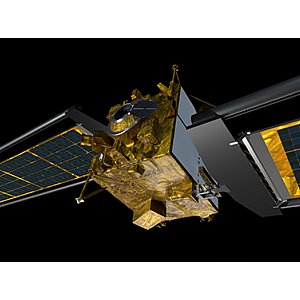
Our DART spacecraft is on track to intentionally crash into the asteroid moonlet Dimorphos on Sept. 26. The views in this composite image of the Jupiter system were captured during recent testing with the spacecraft’s imager and guidance systems to target and track Jupiter’s moon Europa as it emerged from behind the planet, similar to how Dimorphos will visually separate from Didymos, the larger asteroid it orbits. DART, the world’s first planetary defense test mission, is designed to deflect and alter the course of an asteroid should one ever be discovered that is a threat to Earth. Neither Dimorphos nor Didymos is a threat to Earth.
Successful Impact for First-Ever Planetary Defense Test
On Sept. 26, NASA’s Double Asteroid Redirection Test, or DART spacecraft successfully impacted Dimorphos – the asteroid the spacecraft had been on a collision course with for about 10 months.
“Waiting … (applause) … and we have impact!”
DART’s intentional crash into Dimorphos, a moonlet of a larger asteroid called Didymos, was an attempt to alter the course of an asteroid in space as part of the world’s first planetary defense technology demonstration. The DART team will observe Dimorphos with ground-based telescopes to confirm that the technique, known as kinetic impact, did indeed alter the moonlet’s orbit around Didymos. The cosmic collision was actually captured by our Hubble and Webb space telescopes, marking the first time that Webb and Hubble observed the same celestial target at the same time. Neither of these asteroids is a threat to Earth, but this technique could prove to be a reliable way to alter the course of an asteroid that is on a collision course with Earth in the future.
Hurricane Ian Seen from the Space Station
On Sept. 26, external cameras aboard the International Space Station captured views of Hurricane Ian just south of Cuba as the storm moved toward the north-northwest. As expected, Ian intensified as it approached Florida. Space station cameras caught the storm again on Sept. 28 as it was making landfall in southwest Florida as a Category 4 storm with winds upward of 155 mph and a potentially catastrophic storm surge.
Artemis I Rocket Rolled Back Inside Ahead of Hurricane Ian
On the night of Sept. 26, the team at our Kennedy Space Center began moving our Artemis I Moon rocket from launch pad 39B back to the Vehicle Assembly Building, or VAB. The Space Launch System rocket and Orion spacecraft were secured inside the VAB the next morning. Managers decided on the “roll back” due to weather predictions related to Hurricane Ian. In addition to protecting the integrated rocket and spacecraft, they also wanted to give employees time to address the needs of their families ahead of the storm.
Juno’s Close Flyby of Jupiter’s Icy Moon Europa
The spacecraft for our Juno mission at Jupiter made a close flyby of the planet’s ice-covered moon, Europa on Sept. 29. This image from the pass, some 220 miles above Europa’s surface, is the first to come of some of the highest-resolution images ever taken of portions of the moon. Valuable data are also expected from the flyby that, once processed, could benefit and inform future missions, like the agency’s Europa Clipper mission, which is targeted to launch in 2024 to study the icy moon. More information is available at: nasa.gov/juno.
Inflatable Habitat Burst Pressure Test
Believe it or not, these inflatable habitats are being blown up to help make them safe for humans. Habitats like these could be used to house astronauts on future long-term surface exploration missions to the Moon and, eventually Mars. But before then, NASA and commercial partners are conducting burst pressure tests to determine the maximum internal pressure these habitats can safely withstand before they fail.
That’s what’s up this week @NASA … For more on these and other stories, follow us on the web at nasa.gov/twan.
- The 8th Day – Airs Sundays 6:00a - 7:00a on Marquette County's Sunny 101.9 & online http://8thday.buzz
- The show also Airs Sundays 6:00a - 7:00a on WFXD.com, Fox Sports Marquette 105.1/Gwinn 99.9, GTO.FM 97.5 FM, and WRUP 98.3
- A mediaBrew Communications Community News Partner
- Most content from State and National News is broadcast/posted unedited, without bias or favor to content
- While our show airs speeches (usually unedited), debates, bona fide news interviews or scheduled newscasts, news of local and state and national interest, or an on-the-spot news event, we still welcome alternative points of view, and we encourage those with other points-of-view to write mediaBrew Communications Llc. 3060 US 41 West, Marquette, Michigan 49855 about interviews or similar content we may have previously aired, or to report legitimate news tips.