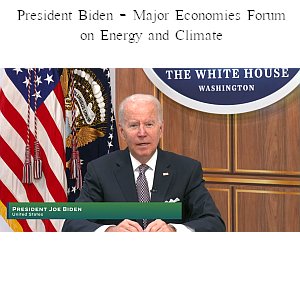
President Biden – Major Economies Forum on Energy and Climate
Washington, D.C. – June 17, 2022 – THE PRESIDENT: Thank you, John. Hello, everyone. And thank you for, whatever time zone you’re in, making the time to be here. I appreciate it very much.
Listen:
- mediaBrew Media Player: ( 10 Min. mp3)
- Default Device Player: ( 10 Min. mp3)
You know, we’re meeting today at a moment when — where there’s urgent global issues impacting all of our nations, demand our immed- — and they all demand our immediate action and our close cooperation.
Russia’s brutal and unprovoked assault on its neighbor, Ukraine, has fueled a global energy crisis and has sharpened the need to achieve long-term, reliable energy security and stability.
And with Russia’s war driving up inflation worldwide, threatening vulnerable countries with severe food shortages, we have to work together to mitigate the immediate fallout of this crisis.
In the United States, I’m using every lever available to me to bring down prices for the American people. And our nations are working together to stabilize global energy markets, including coordinating the largest release from the global reserve — from global oil reserves in history.
But the critical point is that these actions are part of our transition to a clean and secure long-term energy future. And the good news is climate security and energy security go hand in hand.
For example, back in March, the European Commission — with President von der Leyen leading the effort — and I announced the U.S.-EU Task Force on Energy Security to help the EU rapidly reduce its dependence on Russian gas and reduce the EU’s overall demand for gas by ramping up clean energy technologies.
We’ll bolster our energy security and improve the affordability and reliability of energy around the world and reduce our greenhouse gas emissions.
Because we cannot — we cannot afford to let the critical goal of limiting global warming to 1.5 degrees Celsius slip out of our reach.
And the science tells us that the window for action is rapidly narrowing — rapidly.
Glasgow was just the kickoff for a decade of ambition, action, and innovation. And we look toward COP27. We have to — we have to dedicate ourselves, as we look forward to it, to delivering on existing goals and undertaking additional efforts to boost our progress.
So I urge these countries that — those countries that have not yet gone to set a 2030 emissions target to align with the Paris temperature goal, to strengthen their targets for COP27.
At the same time, we need new initiatives to accelerate our progress toward our goals and bolster our resilience.
Here’s what the United States is proposing to maximize efficiency and reduce emissions across the energy, transportation, and agricultural sectors. I hope that many of you will — will join us in these efforts.
First, we should build upon the success of the Global Methane Pledge — now more than 115 countries strong. To do that, we’re announcing the Global Methane Pledge Emer- — excuse me — Energy Pathway to ramp up the speed at which we reduce methane leaks from the oil and gas sector, and also helping bridge our energy needs.
Each year, our existing energy system leaks enough methane to meet the needs for the entire European power sector. We flare enough gas to offset nearly all of the EU’s gas imports from Russia. And so, by stopping the leaking and flaring of this super-potent greenhouse gas, and capturing this resource for countries that need it, we’re addressing two problems at once.
Second, we’re investing in innovation and hastening the scale-up of new technologies like carbon capture and advanced nuclear and clean hydrogen. The International Energy Agency says we need 90 billion dollars’ worth of demonstration projects for this decade. And thanks to the Bipartisan Infrastructure Law that was passed here in the United States, we’re stepping up with a $21.5 billion contribution toward this goal.
For example, we’ve launched a multibillion-dollar effort to create hydrogen hubs all around the country. And using the Defense Production Act, in our system, to boost the manufacturing of electrolyzers, which are used to produce clean hydrogen. We’ve done — we’re doing both these things.
Our Department of Energy also just issued a loan guarantee to construct one of the world’s largest clean hydrogen storage facilities.
And I challenge us, together, to hit the full $90 billion target by the Global Clean Energy Action Forum that the U.S. is hosting in September in Pittsburgh.
Third, Russia’s war is driving up prices of gas — everybody knows that — hurting people in all our countries. It’s an immediate problem that I suspect all of you and I know I’m working every day.
Over the long run, we can remove the pain of volatile gas prices and reduce transportation emissions by putting more zero-emission cars on the road.
In the United States, we’re building a nationwide network of 500,000 electric vehicle charging stations. We’re strengthening our supply chains for the critical materials that go into those batteries. And we’ve set a goal of ensuring that half of all passenger cars sold in the United States in 2020 will be zero — 2030, I should say — will be zero emission. I urge all of you to join us in a similar goal.
Fourth, if ocean-based shipping were a country, it would be the eighth-largest emitter in the world. It’s critical we do more to promote zero-emission fuels and green shipping corridors in this sector. And it seems to me we ought to be able to do that. That’s why the United States and Norway are launching the Green Shipping Challenge to fully decarbonize shipping by 2050.
And finally, Russia’s war in Ukraine is worsening food insecurity, in part due to the skyrocketing price of fertilizer. Fertilizer production relies on natural gas, but more than 50 percent of nitrogen fertilizers are lost globally every year due to waste.
So today, the United States is launching a new Global Fertilizer Challenge. Let’s aim to raise at least $100 million toward increasing fertilizer efficiency and developing alternatives by COP27.
And to keep strengthening our adaptation efforts, this year, the United States is going to partner with Egypt on the Adaptation in Africa event to deliver concrete initiatives that are going to improve people’s lives and build resilience in — to a changing climate.
These are all achievable goals, in my view. And if we all commit to doing our part, we’ll get it done. And if we do, we’ll unlock an incredible opportunities for all our people around the world: more growth, more innovation, more good-paying jobs that support working families, greater food security for communities around the world, and we’ll finally break our dependence on the volatile energy markets and high gas prices.
So thank you all again for taking the time to — this morning, today, tonight — whatever the timeframe it is — for what — and joining us. So let’s keep this challenge — let’s keep doing what we — what we’ve been doing. Challenge ourselves to do more, because we can.
Thank you all so very much for listening. I’m anxious to hear what you all have to say. Thank you. Thank you, John.
- The 8th Day – Airs Sundays 6:00a - 7:00a on Marquette County's Sunny 101.9 & online http://8thday.buzz
- The show also Airs Sundays 6:00a - 7:00a on WFXD.com, Fox Sports Marquette 105.1/Gwinn 99.9, GTO.FM 97.5 FM, and WRUP 98.3
- A mediaBrew Communications Community News Partner
- Most content from State and National News is broadcast/posted unedited, without bias or favor to content
- While our show airs speeches (usually unedited), debates, bona fide news interviews or scheduled newscasts, news of local and state and national interest, or an on-the-spot news event, we still welcome alternative points of view, and we encourage those with other points-of-view to write mediaBrew Communications Llc. 3060 US 41 West, Marquette, Michigan 49855 about interviews or similar content we may have previously aired, or to report legitimate news tips.
FACT SHEET: President Biden to Galvanize Global Action to Strengthen Energy-Security and Tackle the Climate Crisis through the Major Economies Forum on Energy and Climate
President Biden today will reconvene leaders of the Major Economies Forum on Energy and Climate (MEF) to galvanize actions that will strengthen energy security, enhance the resilience of global food security, and tackle the climate crisis. These actions are all the more urgent following Russia’s further invasion of Ukraine, which has disrupted energy markets, strained economies with rising prices, and threatened vulnerable countries with severe food shortages.
At today’s meeting, President Biden’s third MEF convening since taking office, world leaders will raise ambition and, following U. S. leadership, join new efforts and initiatives aimed at tackling the climate crisis while advancing energy security and food security, including:
- Global Methane Pledge Energy Pathway: Tackling methane leaks, venting, and flaring from the oil and gas sector by capturing wasted gas and bringing it to market — bolstering our energy security and climate goals;
- Collective 2030 Zero-Emission Vehicle Goal and Green Shipping Challenge: Putting more zero-emission vehicles on the road and decarbonizing ocean-based shipping — reducing emissions in the transport sector while breaking our dependence on volatile oil markets and prices;
- Clean Energy Technologies Demonstration Challenge: Speeding the commercialization of new technologies — enabling us to break dependence on other unabated, volatile fossil fuels and advance the clean energy transition; and
- Efforts to Enhance Food Security: Increasing fertilizer efficiency and alternatives — reducing agriculture emissions while bolstering global food security.
The major economies that compose the MEF together account for roughly 80 percent of global GDP and global greenhouse gas emissions. Leader-level MEF meetings convened by President Biden in April and September 2021 contributed to the progress achieved at the United Nations Climate Change Conference in Glasgow (COP 26), where new commitments and initiatives brought the world much closer to keeping a 1.5-degree Celsius limit on warming within reach.
The MEF meeting will continue President Biden’s consistent engagement with leaders since Glasgow to further accelerate climate action, including at the recent meeting of the Quad, the U.S.-ASEAN Special Summit, the launch of the Indo-Pacific Economic Framework for Prosperity, and this month’s Summit of the Americas.
Citing a recent round of international scientific assessments urgently underscoring the narrowing window for decisive action, President Biden will urge leaders to step up their climate efforts and to achieve further progress at COP 27 this November in Sharm el-Sheikh, Egypt. He will emphasize that the market disruptions triggered by the Ukraine crisis underscore the urgency of accelerating the clean energy transition — to alleviate both climate and energy security risks — and enhancing the resilience of the global food system.
To this end, several countries are expected to announce new 2030 emission targets as part of their nationally determined contributions (NDCs) under the Paris Agreement, with many intending to strengthen their existing 2030 NDC targets before COP 27. Leaders will also join collective efforts launched by President Biden across the energy, transportation and agriculture sectors, as described below.
The President will underscore that as we come together to reduce emissions, we must also continue to drive progress on adaptation. To this end, President Biden and Egyptian President Abdel Fattah El-Sisi will announce that the United States and Egypt will partner on an Adaptation in Africa event, focusing on tangible steps to improve people’s lives and build climate resilience.
GLOBAL METHANE PLEDGE ENERGY PATHWAY:
Increasing Energy Security and Reducing Near-Term Warming by Capturing Flared, Vented, and Leaked Methane in the Oil and Gas Sector
Every year, the world flares, vents, or leaks an amount of natural gas equivalent to over one-third of Russia’s annual gas production. At the same time, the International Energy Agency (IEA) estimates that nearly half of the oil and gas sector’s methane emissions can be captured and utilized at no net cost. Methane emissions account for nearly half of net warming to date, and rapidly reducing them is the most effective strategy to avoid near-term warming. Stronger action in the oil and gas sector is the fastest and most cost-effective way to cut global methane emissions, with the potential to avoid nearly 0.1-degree C of warming by mid-century—equivalent to eliminating the greenhouse gas emissions of the entire road transport sector. These steps have the dual benefit of increasing global gas supplies from existing production, simply by capturing gas that is otherwise wasted and bringing it to market.
At the September 2021 MEF meeting, the United States and the European Union invited other countries to join them at COP 26 in launching the Global Methane Pledge (GMP) to reduce global anthropogenic methane emissions at least 30 percent below 2020 levels by 2030. And today, building on the success of the GMP, the United States and the European Union invited countries to join the new GMP Energy Pathway, to advance global progress on climate and energy security. The GMP Energy Pathway aims to encourage all nations to capture the maximum potential of cost-effective methane mitigation in the oil and gas sector, and to eliminate routine flaring as soon as possible, and no later than 2030. Participating countries commit to support these efforts by providing new technical and financial resources and/or by enhancing domestic project and policy action. The initiative will bring together some of the most significant global gas producers and consumers in the world. To support the GMP Energy Pathway, the United States will provide $3.5 million in technical assistance through the Global Methane Initiative, and intends to support a transfer of at least $1.5 million remaining in the Pilot Auction Facility to the World Bank Global Gas Flaring Reduction Partnership.
Domestically, the U.S. is continuing its progress in reducing oil and gas methane emissions across the value chain, supporting American gas companies in cutting emissions and saving consumer costs. Building upon the new source performance standards and emissions guidelines proposed in November 2021, the Environmental Protection Agency will issue a supplemental proposed rule for public comment in 2022 to reduce methane and other air emissions from new and existing oil and gas facilities. The Department of Interior is evaluating new regulations to reduce the wasteful flaring and venting of gas produced on public lands. The Department of Transportation is developing a comprehensive set of safety-related regulations that aim to reduce methane emissions from gas pipeline systems that stretch from production-related gathering lines, through trunk line transmission pipelines, and into local distribution pipelines. In addition, new funding provided under the Bipartisan Infrastructure law is enabling the Department of Transportation to spend $1 billion on replacing unsafe and leaking gas distribution pipelines.
CLEAN ENERGY TECHNOLOGIES DEMONSTRATION CHALLENGE:
Raising $90 Billion for High-Priority Demonstration Projects This Decade
Achieving net-zero emissions by 2050 requires developing and scaling innovative clean technologies not yet commercially available. The IEA’s Net Zero by 2050 roadmap identifies at least $90 billion in public investments needed by 2026 for large-scale clean energy technology demonstration projects around the world to be completed this decade. Investing in the first several commercial-scale demonstrations of transformative technologies during this decade will enable their large-scale deployment to achieve global net-zero emissions by midcentury in every sector of the economy, including heavy industry and long-distance transport. Targeted technologies could include, for example, clean hydrogen, carbon dioxide removal, grid-scale energy storage, industrial decarbonization and carbon capture, advanced nuclear, advanced clean fuels, and next-generation offshore wind.
At the MEF meeting, the President will challenge other countries to join the United States in supporting a collective goal to reach the $90 billion in public investment recommended by the IEA. These public investments will leverage additional private investments and advance innovative technologies already in demand by the world’s largest companies through the First Movers Coalition launched by the United States and the World Economic Forum. The President will invite interested countries to come prepared to announce specific investment levels at the Global Clean Energy Action Forum that the United States is hosting this September in Pittsburgh, along with preliminary action plans identifying how they will deploy these technologies to promote an inclusive and equitable transition.
Under the Bipartisan Infrastructure Law signed by President Biden, the United States is devoting $21.5 billion to high-priority clean technology demonstration projects. And just last week the President invoked the Defense Production Act to boost manufacturing of electrolyzers that will be used to produce clean hydrogen and the Department of Energy recently issued a loan guarantee to construct one of the world’s largest clean hydrogen storage facilities.
COLLECTIVE 2030 ZERO-EMISSION VEHICLE GOAL:
Reducing Emissions and Dependence on Volatile Oil Markets by Accelerating Zero-Emission Vehicle Deployment
Achieving net zero will require a profound transformation of other sectors, including transportation. To keep a 1.5 C limit within reach, the global market share of zero-emission vehicles (ZEVs) must reach at least 50 percent of new light-duty vehicle sales by 2030. In some advanced economies, transportation is the single-largest emitting sector and vehicle purchases are causing rapid emissions growth in many developing economies.
Accelerating the deployment of ZEVs will also have the additional benefit of reduced oil dependence — enhancing energy security and insulating economies from price volatility driven by geopolitical and other supply disruptions. Accelerated ZEV deployment will also improve public health by reducing emissions of conventional pollutants.
With the support of automakers, labor, and states, President Biden earlier this year set a goal of ZEVs – including battery electric, fuel cell electric, and plug-in hybrid vehicles – achieving 50 percent of all new light-duty U.S. vehicle sales in 2030. At the MEF, the President will invite participants to join the United States in a collective goal of 50 percent ZEVs by 2030. By accelerating action in key markets, this collective goal will help speed a fully global transformation of the automotive sector. Other countries are invited to join the ZEV deployment goal on the road to COP 27.
To advance this goal in the United States, the Environmental Protection Agency and Department of Transportation have, working closely together, finalized stronger vehicle standards through 2026 and are now considering ambitious standards to at least 2030. The Biden Administration is also implementing the Bipartisan Infrastructure Law to deploy $7.5 billion in funding for a national network of electric vehicle chargers and more than $7 billion to build a strong domestic battery supply chain and create high-quality jobs.
GREEN SHIPPING CHALLENGE:
Catalyzing Action This Decade to Decarbonize Ocean-Based Shipping
Emissions from the shipping sector are significant, rising, and on a trajectory incompatible with the goals of the Paris Agreement. If shipping were a “country,” it would be the world’s eighth-largest emitter. At COP 26, many countries, recognizing the urgency of reducing emissions from the shipping sector, joined the Declaration on Zero Emission Shipping by 2050 and the Clydebank Declaration supporting the establishment of green shipping corridors. The United States also announced in 2021 that it is co-leading the Zero-Emission Shipping research Mission in Mission Innovation together with Norway and Denmark. Further efforts on shipping decarbonization followed at the recent Our Ocean Conference co-hosted by the United States and Palau.
To build on these efforts, the United States and Norway will announce the launch of a Green Shipping Challenge for COP 27. This initiative encourages governments, ports, maritime carriers, cargo owners, and others in the shipping value chain to come forward with concrete steps that will help put the international shipping sector on a credible pathway this decade toward full decarbonization no later than 2050. These could include, for example, steps to produce zero-emission fuels; develop zero-emission bunkering and recharging capabilities; deploy low- or zero-emission vessels; and create, or provide financial and technical support for, green shipping corridors. President Biden will invite leaders to express their support for the Green Shipping Challenge and to announce specific actions under the initiative at COP 27.
GLOBAL FERTILIZER CHALLENGE:
Strengthening Food Security and Reducing Agriculture Emissions by Advancing Fertilizer Efficiency and Alternatives
Russia’s further invasion of Ukraine has shocked the global food system, showing just how vulnerable it is to disruption. Wheat and fertilizer prices have increased more than 40 percent in some regions, exacerbating food insecurity concerns globally. Even before the invasion, food and fertilizer prices were rising as a result of the combined effects of the COVID-19 pandemic, climate-related impacts, armed conflicts, and low supply-chain resilience. Climate-driven food security shocks will continue to cause food scarcity and suffering if steps are not taken to increase food system resilience.
Inability to access fertilizer hampers agricultural productivity in many low-income countries, while in most major economies, more than 50 percent of fertilizers do not reach the intended crop. A 10 percent reduction in global fertilizer loss and waste would free up more than the total amount of mineral fertilizer used by all African countries. In addition, nitrogen fertilizer production consumes up to 4 percent of global natural gas supply; increasing fertilizer efficiency in the short term and transitioning to more affordable alternatives in the medium term will reduce natural gas dependence. Steps to increase the adoption of innovative, alternative, and efficient fertilizer and cropping practices will alleviate pressure on fertilizer and natural gas supplies, increase fertilizer availability, lower nitrous oxide emissions, and reduce food insecurity globally.
In recent months, as part of a continuing effort to add resilience to the agriculture and food supply chains, the United States has established a $500 million program to support innovative and sustainable U.S. fertilizer production and has strengthened support to farmers for the use of precision agriculture and other techniques to improve fertilizer use efficiency.
To spur broader efforts, President Biden will invite countries to join the United States in launching the Global Fertilizer Challenge with the goal of raising $100 million in new funding by COP 27. The Global Fertilizer Challenge will support innovative research, demonstrations, and training to help countries with high fertilizer usage and loss adopt efficient nutrient management and alternative fertilizers and cropping systems. It will be implemented in partnership with the Agriculture Innovation Mission for Climate, which now has over 200 government and non-government partners.
###