Rand Paul and AOC – Speak on Abuse of Power
Listen:
- mediaBrew Media Player: ( 11 Min. mp3)
- Default Device Player: ( 11 Min. mp3)
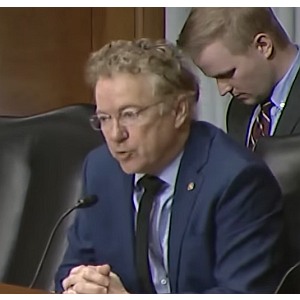
Senator Paul. Our founders debated extensively over which branch of government should have the power to declare or initiate war. Virtually unanimously, they decided, and what was entered into the Constitution was that the declaration or initiation of war would be the power of Congress.
Now we have many advocates, many of whom are here today, who have been advocates for an expansive notion of presidential power. They often argue that wars are not really wars, that they’re kinetic actions or drug busts. I think, though, if you reverse the circumstances, it becomes very difficult for these arguments to hold up.
So I would ask you, if a foreign country bombed our air defense missiles, captured and removed our president, and blockaded our country, would that be considered an act of war? Well, I think your question is about the – and I will acknowledge you’ve been very consistent on all these points the entire career. So let me – no matter who’s in charge. So I will point to two things.
The first is it’s hard for us to conceive that an operation that lasted about four and a half hours and was a law enforcement operation to capture someone we don’t recognize as the head of state, indicted in the United States, wanted with a $50 million bounty. My question would be if it only took four hours to take our president. It’s very short.
Nobody dies on the other side. Nobody dies on our side. It’s perfect.
Would it be an act of war? We just don’t believe that this operation comes anywhere close to the constitutional definition of war. But would it be an act of war if someone did it to us? Nobody dies, few casualties. They’re in and out.
Boom, it’s a perfect military operation. Would that be an act of war? Of course it would be an act of war. I’m probably the most anti-war person in the Senate, and I would vote to declare war if someone invaded our country and took our president.
So I think we need to at least acknowledge this is a one-way argument. One-way arguments that don’t rebound, that you can’t apply to yourselves, that cannot be universally applicable are bad arguments. So my next question would be let’s say it’s not a war.
We’re just going to define it away and say it’s not a war. That’s one of the arguments. So it’s a drug bust.
What if a foreign country indicts our president for violating a foreign law? Should we extradite our president, or should we be okay if they come in and get him by force? Look, I think ultimately we’re always going to act in our national interest. And so if somebody comes after our national interest, like the case you’ve described, which obviously does not exist at this time, but the case you’ve described, the U.S. always has the right to act in its national interest and to protect itself. I don’t know about this equivalency.
Does this justify them doing it? We’re always going to do what’s best for the United States and America. We’re always going to protect our system. But the point isn’t – and you’re exactly right.
We will act in our national interest, and we should. So I’m not disagreeing with you at all. What I’m saying is that our arguments are empty then.
The drug bust isn’t really an argument. It’s a ruse. The war argument, not a war, is a war, is a ruse.
It’s not a real argument. And we do what we do because we are – we have the force. We have the might.
We do it because it’s in our interest. So we wouldn’t let anybody come in, bomb us, blockade us, and take our president. We’ve had arguments about legitimate, illegitimate presidents, bad elections, rigged elections.
So there’s all kinds of same arguments that we’ve had in our country that they’ve had in Venezuela. But we wouldn’t argue for an indictment. And these things aren’t idle speculation.
I mean, Netanyahu has been indicted by the ICC. And one of the reasons I object to being part of the ICC, and I would say you and the administration probably agree, is we’re not going to let any international counsel indict our president and arrest him somewhere on foreign soil. We’re not going to do that.
We actually – most of us probably object to indicting Netanyahu in that way as well. So I think the arguments are invalid. So we did get the legal opinion that Senator Kaine referred to, the OLC opinion, Office of Legal Counsel.
And I think a lot of it’s been released. Plus they came to our caucus and talked most openly about everything they had classified. So I will talk about at least one of the arguments.
They say this war wasn’t a constitutional war, therefore it doesn’t rise to the constitutional notion of us declaring or having to initiate the war. It just doesn’t rise. And one of their main arguments was not enough people died.
And so there is some number that they – they aren’t specific, but there is some number. I would assume, although I’m not positive, that the 50,000, 60,000 soldiers who died in Vietnam might be enough for them to call that a war. But here’s the problem.
It isn’t the number. It’s that it happens in retrospect. See, our founders gave us the power to initiate or declare war.
They didn’t give us other powers to execute the war. Those are left to the president. But if we have to wait to see how many people are killed, we have to wait, as they describe it, as the scope, nature, and extent.
If we have to wait to see the scope, nature, and extent, the war has been going on for some time. It’s hard to vote to initiate a war that’s been going on. And we can say this war is over, but we’re still blockading it.
And we may go back in. But there are no clear answers. We put 2,000.
We move 2,000 troops in. Are we going to call that war and initiate it? So the definition of war is very important. And I think we have to acknowledge the problems with our argument.
Calling things kinetic action is a disservice to our soldiers. You weren’t really wounded in war. You don’t have a Medal of Honor for war.
You have a Medal of Honor for kinetic action. So I think let’s call it what it is. And let’s vote on these things.
But I think we’re in violation of both the spirit and the law of the Constitution by bombing a capital, blockading a country, and removing elected officials. And we certainly wouldn’t tolerate it, nor would I, if someone did it to us. We didn’t remove an elected official.
We removed someone who was not elected, and it was actually an indicted drug trafficker in the United States. Our laws, indicted under our laws. Look, Bolsonaro says that da Silva is not really the president of Brazil.
Our president said Biden wasn’t really the president. Hillary Clinton said in 2016 Trump wasn’t the president. So you have these arguments.
And I agree with you. It probably was and most likely was. Most assuredly was a bad election.
He wasn’t really elected. But at the same time, if that’s our predicate, and you don’t have to come to us because it’s a drug bust, we’re just removing somebody, you can see where it leads to, and it leads to chaos. And that’s why we have rules like the Constitution so we don’t get so far out there that presidents can do whatever they want.
It is this check and balance. And I would argue for 70 years we’ve been going the wrong way. It isn’t just this president, but it’s a debate that I think is worth having.
Mr. Joyner, you are the CEO of CVS Health, correct? CVS Health owns Aetna, the health insurance company, correct? Correct. And CVS, which owns Aetna, also owns Oak Street Health Medical Clinics, correct? Yes, it does. CVS Health also owns CVS Caremark, the pharmacy benefit manager, which helps negotiate some of these rebates and prescription prices, correct? That’s correct.
CVS Caremark helps determine the prices that patients pay for a third of all prescriptions in the U.S. In fact, I was following one of CVS’s investor calls where they really laid out quite clearly what this means if you are a patient. This is what’s known as a captive strategy. And CVS in the investor call used the example themselves of a patient known as Kate.
Kate has an Aetna health insurance plan right here, which is owned by CVS Health. She then goes to a CVS pharmacy. She’s connected to an Oak Street Health Medical Clinic.
She sees a doctor at Oak Street Health who prescribes her medication. And then she goes to fill that prescription at a CVS pharmacy. So the price Kate pays for that medication is dictated by Aetna, CVS Caremark, and they also own the drug manufacturer Cordovus.
Mr. Joyner, this is quite a bit of market concentration. Wouldn’t you agree? No, I wouldn’t agree that it’s market concentration. I would suggest it’s a model that works really well for the consumer.
Yeah. I think it works very well for CVS. I think, in fact, you all said on the call that a fully engaged member unlocks sizable value for payers and CVS Health.
So the health insurance gets a cut. The pharmacy benefit manager gets a cut. The drug manufacturer gets a cut.
And the patient gets screwed. I think the Federal Trade Commission has also found that health care conglomerates like CVS Health charge more for medications filled at their pharmacies. We’re talking about 1,000 percent markups on medications for cancer and HIV.
And, you know, I think this is actually an interesting point of common ground that I may have with some of our Republican colleagues here in this hearing, because whether you’re a blue-blooded capitalist or a card-carrying Democratic socialist, I think corporate monopolies are a problem. And this vertical integration is destroying people’s ability to access care. You know, I don’t think we’re seeing this across the board.
And if they can self-deal, you know, I saw something that was interesting from the opening statement of Mr. Hemsley from United Health talking about how much United spends. Was it 85 percent on care, Mr. Hemsley? Approaching 90 percent. Approaching 90 percent.
But the ACA forces you all to spend a decent amount of that on subsidies on care. But when you own the care, when the insurer owns the pharmacy, owns the PBM, owns the drug manufacturer, you also own the health care cost. You own a big chunk of the health care cost.
And so, you know, 100 years ago, we had this type of market concentration in our banks. And we did something about it when it crashed the economy. And we passed the Glass-Steagall Act.
We should be considering that in our health care system. And if we believe in competition, I think we should put our votes and our legislation in alignment with that and consider breaking up this industry in order to allow the competition that prevents this kind of vertical integration and abuse of power.
- The 8th Day – Airs Sundays 6:00a - 7:00a on Marquette County's Sunny 101.9 & online http://8thday.buzz
- The show also Airs Sundays 6:00a - 7:00a on WFXD.com, Fox Sports Marquette 105.1/Gwinn 99.9, GTO.FM 97.5 FM, and WRUP 98.3
- A mediaBrew Communications Community News Partner
- Most content from State and National News is broadcast/posted unedited, without bias or favor to content
- While our show airs speeches (usually unedited), debates, bona fide news interviews or scheduled newscasts, news of local and state and national interest, or an on-the-spot news event, we still welcome alternative points of view, and we encourage those with other points-of-view to write mediaBrew Communications Llc. 3060 US 41 West, Marquette, Michigan 49855 about interviews or similar content we may have previously aired, or to report legitimate news tips.