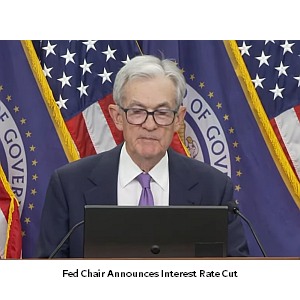
Fed Chair Announces Interest Rate Cut
Listen:
- mediaBrew Media Player: ( 8 Min. mp3)
- Default Device Player: ( 8 Min. mp3)
Summary
- The Federal Open Market Committee is focused on achieving maximum employment and stable prices, despite recent delays in federal data due to a government shutdown.
- Employment conditions are gradually cooling, and inflation remains elevated; thus, the Committee has decided to lower the policy interest rate by 0.25%.
- Economic activity is expanding moderately, with GDP growth slowing to 1.6% in the first half of the year, primarily driven by stronger consumer spending.
- Business investments continue to grow, while the housing sector shows weakness; the shutdown is expected to negatively impact economic activity temporarily.
- Job growth has slowed significantly, attributed to reduced labor force participation and demand, although unemployment remains low.
- Inflation has decreased since mid-2022 but remains above the 2% target, with rising prices in goods due to tariffs, posing both short-term and long-term risks.
- The Committee’s policy approach is not predetermined; discussions on future rate adjustments show differing views on the path forward.
- The balance sheet normalization will shift to a stable holding phase in December, allowing continued adjustments to composition while supporting monetary policy goals.
Transcript
Good afternoon. My colleagues and I remain squarely focused on achieving our dual-mandate goals of maximum employment and stable prices for the benefit of the American people. Although some important federal government data have been delayed due to the shutdown, the public and private sector data that have remained available suggest that the outlook for employment and inflation has not changed much since our meeting in September.
Conditions in the labor market appear to be gradually cooling, and inflation remains somewhat elevated. In support of our goals and in light of the balance of risks to employment and inflation, today the Federal Open Market Committee decided to lower our policy interest rate by a quarter percentage point. We also decided to conclude the reduction of our aggregate securities holdings as of December 1. I will have more to say about monetary policy after briefly reviewing economic developments.
Available indicators suggest that economic activity has been expanding at a moderate pace. The GDP rose at a 1.6 percent pace in the first half of the year, down from 2.4 percent last year. Data available prior to the shutdown show that growth in economic activity may be on a somewhat firmer trajectory than expected, primarily reflecting stronger consumer spending.
Business investment in equipment and intangibles has continued to expand, while activity in the housing sector remains weak. The shutdown of the federal government will weigh on economic activity while it persists, but these effects should reverse after the shutdown ends. In the labor market, the unemployment rate remained relatively low through August.
Job gains have slowed significantly since earlier in the year. A good part of the slowing likely reflects a decline in the growth of the labor force due to lower immigration and labor force participation, though labor demand has clearly softened as well. Although official employment data for September are delayed, available evidence suggests that both layoffs and hiring remain low and that both households’ perceptions of job availability and firms’ perceptions of hiring difficulty continue to decline.
In this less dynamic and somewhat softer labor market, the downside risks to employment appear to have risen in recent months. Inflation has eased significantly from its highs in mid-2022, but remains somewhat elevated relative to our 2 percent longer-run goal. Estimates based on the Consumer Price Index suggest that total PCE prices rose 2.8 percent over the 12 months ending in September and that, excluding the volatile food and energy categories, core PCE prices rose 2.8 percent as well.
These readings are higher than earlier in the year as inflation for goods has picked up. In contrast, disinflation appears to be continuing for services. Near-term measures of inflation expectations have moved up on balance over the course of this year on news about tariffs as reflected in both market and survey-based measures.
Beyond the next year or two-or so, however, most measures of longer-term expectations remain consistent with our 2 percent inflation goal. Our monetary policy actions are guided by our dual mandate to promote maximum employment and stable prices for the American people. At today’s meeting, the Committee decided to lower the target range for the federal funds rate by a quarter percentage point to 3 and 3 quarters to 4 percent.
Higher tariffs are pushing up prices in some categories of goods, resulting in higher overall inflation. A reasonable base case is that the effects on inflation will be relatively short-lived, a one-time shift in the price level. But it is also possible that the inflationary effects could instead be more persistent, and that is a risk to be assessed and managed.
Our obligation is to ensure that a one-time increase in the price level does not become an ongoing inflation problem. In the near term, risks to inflation are tilted to the upside and risks to employment to the downside- a challenging situation. There is no risk-free path for policy as we navigate this tension between our employment and inflation goals.
Our framework calls for us to take a balanced approach in promoting both sides of our dual mandate. With downside risks to employment having increased in recent months, the balance of risks has shifted. Accordingly, we judge the impact of inflation And we have suggested appropriate, at this meeting, to take another step toward a more neutral policy stance.
With today’s decision, we remain well positioned to respond in a timely way to potential economic developments. We will continue to determine the appropriate stance of monetary policy based on the incoming data, the evolving outlook, and the balance of risks. We continue to face two-sided risks.
In the Committee’s discussions at this meeting, there were strongly differing views about how to proceed in December. A further reduction in the policy rate at the December meeting is not a foregone conclusion. Far from it.
Policy is not on a preset course. At today’s meeting, the Committee also decided to conclude the reduction of our aggregate securities holdings as of December 1. Our long-stated plan has been to stop balance sheet risk from increasing to a steady runoff when reserves are somewhat above the level we judge consistent with ample reserve conditions. Signs have clearly emerged that we have reached that standard.
In money markets, repo rates have moved up relative to our administered rates, and we have seen more notable pressures on selected dates, along with more use of our standing repo facility. In addition, the effective federal funds rate has begun to move up relative to the rate of interest on reserve balances. These developments are what we expected to see as the size of our balance sheet declined and warrant today’s decision to cease runoff.
Over the three-and-a-half years that we’ve been shrinking our balance sheet, our securities holdings have declined by $2.2 trillion. As a share of nominal GDP, our balance sheet has fallen from 35 percent to about 21 percent. In December, we’ll enter the next phase of our normalization plans by holding the size of our balance sheet steady for a time while reserve balances continue to move gradually lower as other non-reserve liabilities, such as currency, keep growing.
We will continue to allow agency securities to run off our balance sheet and will reinvest the proceeds from those securities in Treasury bills, furthering progress toward a portfolio consisting primarily of Treasury securities. This reinvestment strategy will also help move the weighted average maturity of our portfolio closer to that of the outstanding stock of Treasury securities, thus furthering the normalization of the composition of our balance sheet. The Fed has been assigned two goals for monetary policy- maximum employment and stable prices.
We remain committed to supporting our maximum employment, bringing our inflation sustainably to our 2 percent goal, and keeping longer-term inflation expectations well anchored. Our success in delivering on these goals matters to all Americans. We understand that our actions affect communities, families, and businesses across the country.
Everything we do is in service to our public mission. We at the Fed will do everything we can to achieve our maximum employment and price stability goals. Thank you.
I look forward to your questions.
- The 8th Day – Airs Sundays 6:00a - 7:00a on Marquette County's Sunny 101.9 & online http://8thday.buzz
- The show also Airs Sundays 6:00a - 7:00a on WFXD.com, Fox Sports Marquette 105.1/Gwinn 99.9, GTO.FM 97.5 FM, and WRUP 98.3
- A mediaBrew Communications Community News Partner
- Most content from State and National News is broadcast/posted unedited, without bias or favor to content
- While our show airs speeches (usually unedited), debates, bona fide news interviews or scheduled newscasts, news of local and state and national interest, or an on-the-spot news event, we still welcome alternative points of view, and we encourage those with other points-of-view to write mediaBrew Communications Llc. 3060 US 41 West, Marquette, Michigan 49855 about interviews or similar content we may have previously aired, or to report legitimate news tips.