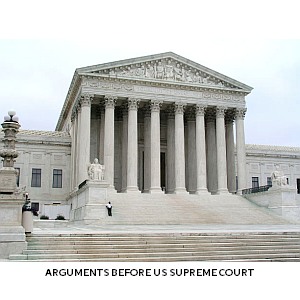
Arguments Before the US Supreme Court April 2026
Listen:
- mediaBrew Media Player: ( 15 Min. mp3)
- Default Device Player: ( 15 Min. mp3)
Mr. Scorsese, I just want to explore, just for a brief minute, your scintilla of conclusive and preclusive power theory. You agree, I assume, the president is vested with all the executive power? Yes. You agree that he has a duty to faithfully execute all the laws? Yes.
Civil and criminal? We agree that the Constitution imposes on the president a duty to faithfully execute the laws. All the laws. Some laws he doesn’t have to? That would be news to our friends across the street.
The Take Care Clause is a duty and it is also a power, but the text of the clause does not provide that the president must have at-will presidential… I didn’t ask that. This is, does he have a duty to faithfully execute all the laws? We know from… Yes or no? I would say no, in the sense… No. In the sense that, let me, there’s two different questions and I want to make sure that I’m answering the question.
The question is, does the president have a duty to faithfully execute all the laws? The answer is no. Why? So he can’t break the law for sure. For sure.
Does he have to be vested with statutory authority to actually enforce, directly enforce, or to… I’m not asking whether he has to bring the indictment. I’m asking whether he has a duty to faithfully execute the laws. I think the president does not, under both history and tradition, have to have plenary power of supervision, but in the case of the FTC, he does have some power of supervision, including if there’s a demonstrable palpable violation of law, the president could absolutely fire a commissioner of the FTC under the plain language of the statute.
So the answer is no, I guess, but you say that he does have to have direct supervision and removal authority for someone who has conclusive and exclusive authority to bring crime, criminal prosecutions, right? That is our understanding of this court’s decision in Trump v. United States. That’s your understanding? Yes. But not civil? That’s right.
And to go back to earlier… And just to be clear, so that means if the government wants to bring a misdemeanor, that person has to be reportable to the president. But if the government wants to bring ruinous fines and penalties and injunctions, that person doesn’t. I don’t know the scope of this court’s holding in Trump v. United States.
I’m asking you for your theory, because it’s a very interesting theory. You’re building off of two words from Trump v. United States and putting a gloss on it that I’m not familiar with. I had understood the executive power and he has conclusive and preclusive authority of that, but this line, I don’t know where it comes from.
I’m wondering, I’ll put my cards on the table, maybe it’s a recognition that Humphrey’s executor was poorly reasoned and that there is no such thing in our constitutional order as a fourth branch of government that’s quasi-judicial and quasi-legislative. Maybe you’re trying to backfill it with a better new theory that itself recognizes that we’ve got a problem. The theory that we are referring to, Justice Gorsuch, as we understand it, is not just based on this court’s recent decision in Trump v. United States.
It goes all the way back to Marbury v. Madison. And Marbury does not use the term conclusive and preclusive, but it absolutely says… And neither does Humphrey’s. It uses quasi things.
It talks about the distinction between authorities that are vested in the president and the president’s powers in the constitutional sense, and executive power in the constitutional sense. And it actually cites Marbury v. Madison for that… Oh sure, I would hope it would. For that proposition.
And Marbury itself distinguishes in the context of removability of federal offices. I guess I’m just wondering, are we going to get… If we take your theory to backfill Humphrey’s and go down this road, how are we supposed to decide which powers are exclusive and preclusive? For your purposes, as you understand it, not as I understand it from Trump v. United States, but as you understand it, what powers are going to fall in and what are going to fall out? Are we going to have just as much litigation over that as anything else we might do in this case? I don’t think so. We’ve had this modern era of traditional independent agencies for a long time.
We haven’t had any precedent ever striking them down, and this court has not been, as far as I know, overwhelmed with difficult questions of line drawing. In fact, from 1935 to 2025, we had pretty much unanimity among courts that traditional independent agencies are fine. To go back… You haven’t had a lot of litigation over Humphrey’s and its limits and its boundaries.
I mean, SELA law, you invoke it as a great decision. We do invoke SELA law as a great decision. We’re always going to have litigation over the separation of powers, aren’t we? There will always be litigation, absolutely, but the point is that this court’s precedents affirming Congress’s authority to work with precedents to create traditional independent agencies has not generated any significant problems, still less insurmountable problems.
Thank you. So, General, on this question of expedition, I mean, it sort of depends on the government’s own actions in a case like this one, where one can expect that there is not going to be a great deal of disagreement among the lower courts. I mean, let’s assume that you lose in the lower courts pretty uniformly, as you have been losing on this issue, and that you never take this question to us.
I mean, I noticed that you didn’t take the substantive question to us. You only took the nationwide injunction question to us. I mean, why would you take the substantive question to us? You’re losing a bunch of cases.
This guy over here, this woman over here, you know, they’ll have to be treated as citizens, but nobody else will. Why would you ever take this case to us? Well, in this particular case, we have deliberately not presented the merits to this Court on the question of the scope of remedies, because, of course, that makes it a clean vehicle, where the Court doesn’t have to look at the past. You’re ignoring the import of my question.
I’m suggesting that in a case in which the government is losing constantly, there’s nobody else who’s going to appeal. They’re winning. It’s up to you to decide whether to take this case to us.
If I were in your shoes, there is no way I’d approach the Supreme Court with this case. So you just keep on losing in the lower courts, and what’s supposed to happen to prevent that? Again, I respectfully disagree with that forecast of the merits, but in response to the question, what I would say is, we have an adversarial system, and if the government is not, for example, not respecting circuit precedent on the Court’s hypothetical in the Second Circuit, someone injured in the Second Circuit could take the case up, and they could say, look, the government is violating circuit precedent on the hypothetical multiple circuits. That’s the case we’re going to take? Somebody who says, you know, after we’ve said that this all has to be done one by one by one, then we’re going to take a case from somebody who objects to precedent one by one by one? I’m not sure I understand the question.
I understood the hypothetical being— If you win this challenge and say there is no nationwide injunction and it all has to be through individual cases, then I can’t see how an individual who is not, you know, being treated equivalently to the individual who brought the case would have any ability to bring the substantive question to us. They would bring a lawsuit in the Federal District Courts against the government for an injunction protecting them, and if the government wasn’t respecting, you know, on the hypothetical circuit precedent— Yeah, and then they win, and again, I mean, you need somebody to lose, but nobody’s going to lose in this case. It’s just, you’re going to have, like, individual by individual by individual, and all of those individuals are going to win, and the ones who can’t afford to go to court, they’re the ones who are going to lose.
The tools that are provided to address hypotheticals like this, again, I— This is not a hypothetical. This is happening out there, right? Every court has ruled against you. We’ve only had snap judgments on the merits.
You know, obviously, we’re fully briefing the merits in the Courts of Appeals, and our arguments are compelling, more fundamentally, in response to the question. I’m suggesting to you, like, the real brunt of my question is, in a case like this, the government has no incentive to bring this case to the Supreme Court, because it’s not really losing anything. It’s losing a lot of individual cases, which still allow it to enforce its CEO against the vast majority of people to whom it applies.
And again, Rule 23 provides an avenue to present—to address those very concerns. Thank you. Justice Gorsuch? General Sauer, I want to ask you about a potential tension—well, no, not a potential tension, an actual tension that I see in answers that you gave to Justice Kavanaugh and Justice Kagan.
You resisted Justice Kagan when she asked you whether the government would obey, within the Second Circuit, a precedent. I’m distinguishing between opinions and judgments here. Did I understand you correctly to tell Justice Kagan that the government wanted to reserve its right to maybe not follow a Second Circuit precedent, say, in New York, because you might disagree with the opinion? Our general practice is to respect those precedents, but there are circumstances when it is not a categorical practice, and that is not just a new policy.
This administration’s practice or the longstanding practice of the federal government? And I’m not talking about in the Fourth Circuit, are you going to respect a Second Circuit. I’m talking about within the Second Circuit. And can you say, is that this administration’s practice or a longstanding one? As I understand it, longstanding policy of the Department of Justice.
Yes, that we generally, as it was phrased to me, generally respect Circuit precedent, but not necessarily in every case. And certain examples, some examples might be a situation where we’re litigating to try and get that Circuit precedent overruled and so forth. Well, OK, so I’m not talking about a situation in which, you know, the Second Circuit has a case from 1955, and you think it’s time for it to be challenged.
That’s not what I’m talking about. I’m talking about in this kind of situation. I’m talking about this week, the Second Circuit holds that the executive order is unconstitutional.
And then what do you do the next day or the next week? Generally, we follow. So you’re still saying generally? Yes. And you still think that it’s generally the policy, longstanding policy of the federal government to take that approach? That is my understanding.
OK, so but it sounds to me like you accept a Cooper versus Aaron kind of situation for the Supreme Court, but not for, say, the Second Circuit, where you would respect the opinions and the judgments of the Supreme Court. And you’re saying you would respect the judgment, but not necessarily the opinion of a lower court. And again, I think in the vast majority of instances, our practice has been to respect the opinion as well, in the circuits as well.
But my understanding is that has not been a categorical practice in the way respect for the precedents and the judgments of the Supreme Court has been. So you’re not hedging at all with respect to the precedent of this Court? That is correct. I believe the quotation from our application directly addresses that, and we stand by that completely.
OK. Next question. So this is also a follow-up to some of the questions that others have asked you about the merits of the order not being before us.
Did I understand your answer to be because you think percolation is really important for this one? We do think percolation is really important for this one. But the reason the merits are not before is because we’ve only submitted a stay application on the scope of relief question. And as Labrador against Poe indicates, the scope of relief is a separate question for them.
Oh, I understand it’s a separate question, but there are plenty of times that the government comes to us and asks for both. Absolutely. For example, recently in the Wilkins and Cox application, we did exactly that.
And the reason why you didn’t ask for both here is because you think that the merits question needs percolation. Yes, but also more fundamentally, it illustrates that the very problem with these nationwide injunctions is they force this rushed, you know, fast and furious decisions on the merits. So I think it would be very inappropriate in this case to come to a stay application saying, please give us a rushed, you know, decision on the merits of something that’s very, very competent.
But the government’s done that in other cases too, right? Those cases would be different. In this case, the example I gave earlier, we think it’s very clear-cut on the merits. You know, this one is, we concede a novel and sensitive question.
So this one isn’t clear-cut on the merits? This one, in this case, we want the court to address the remedial issue. If we offer the merit first, that’s a vehicle problem because the court has, in many cases, just addressed the merits and not the remedial issue. And it’s imperative from the federal government’s perspective that the remedial question be addressed.
Okay, so last question is about why that is. Justice Alito asked you, well, what’s the point of this? If the same thing could happen, which is effectively the EO being enjoined everywhere via class action or because it’s necessary to provide complete relief, say, to the states. Is there any difference in your view between, say, a class is certified of all individual plaintiffs and they win, and the executive order class-wide, there’s a judgment saying that it can’t be enforced.
Do you want to say, you know, follow-up, is there any practical distinction you see? Why does the government care? Is it just the rigors of the certification process or is it something more? The rigors of the certification process, keep in mind that in many of these cases, we successfully oppose class action. Let’s assume, I think, you can’t successfully oppose it here for individual plaintiffs. Well, I mean, that opportunity to have our day in court on that is very, very important.
I understand, but let’s assume, go with my assumption. Assuming that we were to lose in opposing the certification. Assume the class is certified.
Is there any benefit? If a class is certified, and let’s say, you know, you were pointing out that the executive order targets two different kinds of people, let’s assume that it’s commonality because, you know, they only target one portion of the order, right? In that circumstance, does the government get anything different? This is back to Justice Alito’s question about what’s it to you? What’s the practical difference to you? Do you want to say anything about whether there’s a practical difference between a universal injunction and a loss in the class? Absolutely. Among many others, the represented class members are bound in the class action context. And that means that if they lose, they’re bound by that as well.
So they’re taking a grave risk, so to speak, by proceeding through a class action. And it has this symmetry where the government is bound if we lose. They are bound if we don’t lose.
And that’s a very, very important decision. And you would respect that judgment? Yes, if it were a judgment. You know, now we may try to litigate in other contexts to try and get a different judgment from a different district court.
But we would be bound by that judgment, as would they. And that’s the crucial point.
- The 8th Day – Airs Sundays 6:00a - 7:00a on Marquette County's Sunny 101.9 & online http://8thday.buzz
- The show also Airs Sundays 6:00a - 7:00a on WFXD.com, Fox Sports Marquette 105.1/Gwinn 99.9, GTO.FM 97.5 FM, and WRUP 98.3
- A mediaBrew Communications Community News Partner
- Most content from State and National News is broadcast/posted unedited, without bias or favor to content
- While our show airs speeches (usually unedited), debates, bona fide news interviews or scheduled newscasts, news of local and state and national interest, or an on-the-spot news event, we still welcome alternative points of view, and we encourage those with other points-of-view to write mediaBrew Communications Llc. 3060 US 41 West, Marquette, Michigan 49855 about interviews or similar content we may have previously aired, or to report legitimate news tips.