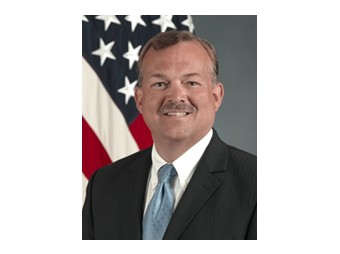
Marquette, Michigan – As an expert in constitutional law and homeland and national security law, associate dean at Cooley Law School in Lansing Brigadier General Michael C.H. McDaniel brings clear-headed explanations to the issues of presidential power, article I of the Constitution, and the role of congress in deciding where money is to be spent by the government. Michael McDaniel also brings a laser-focused academic mind to the issues National Security and the Law since he at Cooley Low School developed an LL.M. program in Homeland and National Security Law.
The topics discussed during this interview:
- The President’s power to declare a national emergency in order to build a wall along the country’s southern border
- Article I, Section 9 and Article II of the Constitution of the United States , and the Power of the Purse to allocate funds
- 30 National Emergencies currently in effect
- Overreach of Executive Power?
- 1979 National Emergencies Act
- President was turned down by both Republican Congress in 2018 and Democratic/Republican Mix in 2019
- Under the law, any emergency — except actual military attack on the U.S.A — must be explained and justified under the law.
- 1952 under Truman, the Supreme Court already addressed this issue in Youngstown Sheet & Tube Co. v. Sawyer during the 1952 Steel Strike
wherein it was definitively declared that the “President had no powers to make laws or, more particularly, to seize property without Congressional authorization” and in the majority opinion “holding that the President had no power to act except in those cases expressly or implicitly authorized by the Constitution or an act of Congress.” - The president has the least power when the congress has already spoken against what the president wants
- The National Emergencies Act leaves much to the president, but not after congress has spoken (especially the recent government shutdown).
- For political reasons, the constitution will likely be ignored in this case, with the president expected to veto any resolution to reverse his declaration of emergency.
- Lawsuits by one branch of government against another branch are frowned upon by the courts, except when the constitutional issues are in play.
- President’s discussion with congress is evidence as well as signing the budget is proof the president acknowledges what congress has determined where money should good
- Only the congress can allocate funds. No funds shall be dispensed by the treasury except as approved by congress
- Government of Limited Powers
- Should the congress and the president follow the constitution?
- The consequences of taking money out of monies allocated to military housing, Puerto Rico, and other areas the congress has not authorized and appropriated
- Congress did not authorize or delegate to the president to re-allocate/re-purpose funding designated for the military for non-military support
- The President can’t take funds allocated by congress to the Department of Defense and re-allocate them to the Department of Homeland Security
- Counter arguments supporting president
- The definition of “Emergency,” and why the congress didn’t define the word
- Why is congress not more concerned with the president usurping congressional power
- Tribal thinking and forgetting how erosion of powers of the people and states can destroy our government and our democratic republic
- Allowing hotheads rather than cooler heads prevail
- Ending reasoned debate can end our country
- Impact of takings of land and eminent domain in border states
- Lessons from the Texas effort to build a wall and failing
- Impact of allowing unilateral actions by president on the future of the American way of life and the U.S. Constitution
- Unchecked power: Give a Little, Lose a Lot
- Oath of Office – 5 U.S. Code § 3331. Oath of office:
An individual, except the President, elected or appointed to an office of honor or profit in the civil service or uniformed services, shall take the following oath: “I, AB, do solemnly swear (or affirm) that I will support and defend the Constitution of the United States against all enemies, foreign and domestic; that I will bear true faith and allegiance to the same; that I take this obligation freely, without any mental reservation or purpose of evasion; and that I will well and faithfully discharge the duties of the office on which I am about to enter. So help me God.” This section does not affect other oaths required by law.
Listen:
- Great Lakes Radio Player: ( 44 Min. mp3)
- Default Device Player: (44 Min. mp3)
[Interview First Broadcast February 16, 2019]
Joint Statement by Cooley Law Constitutional Law Professors on this topic:
“Over the years, Congress has allowed Presidents to assume broad powers when it comes to declaring national emergencies. These powers have grown, and when left unchecked, can create both bad foreign policy and a divisive political issue. Congress needs to better align its delegated authorities with the original intent of the Constitution to prevent further erosion of the definition of emergency. The border wall is the latest test to the emergency powers statute and will surely lead to even broader interpretations in the future if gone unchecked.”
The Whitehouse.GOV Justification for Declaring a National Emergency on southern Border and re-allocating funds:
- In declaring a national emergency, a President may invoke any of more than 100 available statutory authorities. President Trump’s declaration invoked two:
- 10 U.S.C. § 12302 authorizes Department of Defense (DOD) officials to order the Ready Reserve to active duty to address a national emergency.
- 10 U.S.C. § 2808 authorizes the Secretary of Defense to direct military construction necessary to support the use of the Armed Forces in connection with a “national emergency… that requires use of the armed forces.”
- The President reasonably determined that the national emergency at the southern border “require[d] use of the armed forces.”
- An emergency that “requires use of the armed forces” means the President has determined that the armed forces are necessary to address the crisis.
- More than 5,000 troops are deployed at the border.
- DOD is now reviewing which emergency military construction projects, such as the building of barriers, may be “necessary to support” the use of the Armed Forces.
- DOD is still in the process of making such determinations, so no funds have yet been authorized for use.
- Separate from the national emergency, the President invoked two other statutory authorities to direct needed funds to the border.
- Congress expressly authorized the military to support Federal agencies in blocking drug-smuggling corridors across international boundaries, using 10 U.S.C. § 284(b).
- Under 10 U.S.C. § 284(b)(7), the United States military may construct “fences and road and [install] lighting … to block drug smuggling corridors across international boundaries of the United States” upon request from the responsible agency.
- DHS has requested that DOD use this counterdrug authority to construct fencing and roads and to install lighting in high-priority drug-smuggling corridors.
- To devote additional resources to such construction, DOD will augment existing counterdrug funds by transferring up to $2.5 billion from other DOD accounts.
- DOD’s transfer authority is provided in section 8005 of the FY19 DOD appropriations act.
- In past years, DOD has relied upon its general transfer authority to reallocate up to $4 billion from within the DOD budget.
- Under 31 U.S.C. § 9705(g)(4)(B), the Secretary of the Treasury may provide money from the Treasury Forfeiture Fund to other agencies for use “in connection with the law enforcement activities of any Federal agency.”
- Treasury has identified about $601 million that will be made available to DHS for use in law enforcement border security efforts.
PAST USES OF NATIONAL EMERGENCY DECLARATIONS: Presidents have regularly declared national emergencies under the National Emergencies Act.
- Presidents have declared nearly 60 national emergencies since the National Emergencies Act was passed in 1976.
- There were 31 ongoing national emergencies when President Trump declared the national emergency at our border, bringing the total number currently in effect to 32.
- These ongoing national emergencies are reviewed every year by the President—and renewed as appropriate.
- In fact, President Obama declared a national emergency to deal with the threat of transnational criminal organizations, including cartels operating on our southern border.
- Presidents have regularly issued national emergency declarations to address problems overseas.
- President Clinton declared a national emergency in response to the blood diamond trade in Sierra Leone.
- President Obama declared national emergencies related to situations in Somalia, Libya, Yemen, Ukraine, South Sudan, Burundi, and more.
- National emergencies have also been used to address problems domestically, such as when President Obama declared a national emergency in response to the swine flu.
- Between 2001 and 2013, DOD undertook 18 emergency military construction projects using the same emergency construction authority President Trump has invoked.
FUNDING SOURCES: President Trump is using funds appropriated by Congress, funds reallocated under statutory authority, and funds available when a national emergency is declared.
- Nearly $8.1 billion has been identified as available, including:
- $1.375 billion appropriated by Congress
- $3.1 billion under other statutory authorities
- $3.6 billion in military construction funds available under a national emergency
- These funding sources will be used sequentially and as needed, with the $1.375 from appropriated funds used first, then the $3.1 billion from other statutory authorities, then the $3.6 billion from military construction.
- Only $3.6 billion of the nearly $8.1 billion is dependent on the President’s declaration of a national emergency.
- Under the President’s non-emergency statutory authority, $3.1 billion is available.
- $601 million from the Treasury Forfeiture Fund will be made available to support border security.
- The Secretary of the Treasury is authorized to use funds in the Treasury Forfeiture Fund not reserved for other purposes to support law enforcement activities.
- The $601 million will be available in two allocations, $242 million available immediately and $359 million from future anticipated forfeitures.
- Up to $2.5 billion will be made available from DOD funds transferred to its FY 2019 Drug Interdiction and Counter-Drug Activities account.
- This construction to support counterdrug activities will be used on land already owned by the Federal Government.
- $601 million from the Treasury Forfeiture Fund will be made available to support border security.
- Based on the President’s national emergency declaration, DOD is authorized to undertake certain military construction projects using up to $3.6 billion in unobligated military construction funding.
- DOD will ensure that high-priority projects with national security implications remain funded. Family housing projects will remain funded.
- The Administration will ask Congress for new military construction funding for the existing projects affected by this, so that no projects will be canceled—only delayed.
HOW FUNDS CAN BE USED: These funds will be available to help secure the border and protect the safety and well-being of our country.
- The potential projects that could be built using these funds include:
- Constructing new, 18 to 30 foot high steel primary pedestrian barriers in various areas.
- Replacing outdated pedestrian fencing and vehicle barriers with modern, 18 to 30 foot high steel barrier.
- Constructing new secondary barriers to provide a patrol zone in between the secondary and primary barriers.
- The 8th Day – Airs Sundays 6:00a - 7:00a on Marquette County's Sunny 101.9 & online http://8thday.buzz
- The show also Airs Sundays 6:00a - 7:00a on WFXD.com, Fox Sports Marquette 105.1/Gwinn 99.9, GTO.FM 97.5 FM, and WRUP 98.3
- A mediaBrew Communications Community News Partner
- Most content from State and National News is broadcast/posted unedited, without bias or favor to content
- While our show airs speeches (usually unedited), debates, bona fide news interviews or scheduled newscasts, news of local and state and national interest, or an on-the-spot news event, we still welcome alternative points of view, and we encourage those with other points-of-view to write mediaBrew Communications Llc. 3060 US 41 West, Marquette, Michigan 49855 about interviews or similar content we may have previously aired, or to report legitimate news tips.