Canada Prime Minister Carney Says United States World Leadership Gone
Summary
Listen:
- mediaBrew Media Player: ( 17 Min. mp3)
- Default Device Player: ( 17 Min. mp3)
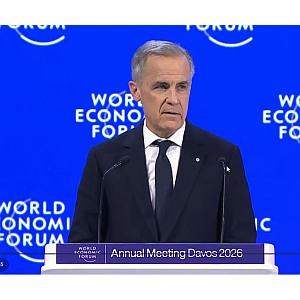
The speech addresses the shifting nature of global power dynamics, emphasizing the challenges faced by middle powers like Canada amid rising great power rivalry and the erosion of the rules-based international order. It critiques the fading effectiveness of multilateral institutions (WTO, UN, COP) and warns against complacency in the face of a world where economic integration is weaponized for coercion by dominant powers.
Key Insights
Middle powers are not powerless. Countries such as Canada possess the capacity to influence global order by fostering values like human rights, sustainable development, sovereignty, solidarity, and territorial integrity.
The current international system, once underpinned by U.S. hegemony, is in a state of rupture, not transition. The past rules-based order was partially a fiction, maintained by collective compliance despite evident inconsistencies and power asymmetries.
Economic integration, once a source of mutual benefit, has become a tool of coercion (tariffs, financial infrastructure, supply chain vulnerabilities).
In response, many nations are pursuing greater strategic autonomy in energy, food, critical minerals, finance, and supply chains to reduce vulnerability.
However, a world fragmented by fortress mentalities will be poorer, more fragile, and less sustainable.
The speech advocates for value-based realism—balancing principled commitments to fundamental values with pragmatic engagement recognizing divergent interests.
Canada is actively shifting its strategic posture by:
Cutting taxes and removing barriers to inter-provincial trade.
Investing heavily in energy, AI, critical minerals, trade corridors, and defense.
Doubling defense spending and fostering domestic industry.
Diversifying international partnerships with the EU, China, Qatar, India, ASEAN, and others.
Canada champions variable geometry coalitions, forming flexible issue-based partnerships grounded in shared values and interests rather than blind multilateralism.
The speech stresses the importance of middle powers acting collectively, creating a “third path” that resists subordination to great powers and emphasizes legitimacy, integrity, and rules.
Honesty about the current state of global affairs is crucial—middle powers must stop pretending the old rules-based order works and instead build new institutions and agreements that function effectively.
Building a strong domestic economy and reducing vulnerabilities are prerequisites for principled foreign policy and sovereignty.
Canada’s strengths include:
Vast reserves of energy and critical minerals.
Highly educated population.
Sophisticated pension funds and fiscal capacity.
A pluralistic, stable, and sustainable society.
The speech concludes by rejecting nostalgia for the old order and embracing the opportunity for middle powers to build a stronger, more just global system based on honesty, cooperation, and shared strength.
Timeline of Relevant Developments
Period Event/Trend Past decades Prosperity under rules-based international order, primarily upheld by U.S. hegemony.Last two decades Crises in finance, health, energy, geopolitics expose risks of extreme global integration.
Recent years Great powers weaponize economic integration (tariffs, coercion, supply chain vulnerabilities).
Present Middle powers shift towards strategic autonomy and pragmatic, value-based foreign policy.
Near future (by end of decade) Canada doubling defense spending and fast-tracking investments in key sectors.
Comparative Overview: Old Order vs. New Reality
Aspect Old Rules-Based Order New Reality / Response
Global power structure U.S.-led hegemony, predictable institutions Great power rivalry, erosion of multilateral institutions
Economic integration Source of mutual benefit Weaponized tool for coercion
Sovereignty Grounded in international rules Anchored in strategic autonomy and resilience
Middle powers’ role Beneficiaries of rules-based order, passive compliance Active agents, building coalitions and domestic strength
Foreign policy approach Values-based, under protection of order Value-based realism: principled yet pragmatic
Multilateralism Reliance on formal institutions Variable geometry, issue-based coalitions
Core Concepts
- Power of the powerless: Inspired by Havel’s idea that systemic power depends on collective compliance with falsehoods; change begins when individuals or states stop pretending.
- Value-based realism: A foreign policy balancing commitment to values with pragmatic recognition of global complexity.
- Strategic autonomy: Reducing dependence on external actors for critical resources and defense capabilities.
- Variable geometry: Flexible coalitions formed around shared interests and values rather than uniform global consensus.
- Economic coercion: Use of trade, finance, and supply chains as tools of geopolitical pressure.
Bulleted Summary of Canada’s Strategic Actions
- Cut taxes on income, capital gains, and business investment.
- Removed federal barriers to inter-provincial trade.
- Fast-tracked $1 trillion investment in energy, AI, critical minerals, and trade infrastructure.
- Committed to doubling defense spending by 2030.
- Strengthening domestic industries linked to defense.
- Diversified trade and security partnerships across multiple continents.
- Joined EU’s SAFE defense procurement arrangement.
- Negotiated free trade agreements with India, ASEAN, Thailand, Philippines, Mercosur.
- Advocated for linking Trans-Pacific Partnership and EU trade blocs.
- Formed critical minerals buyers clubs through G7.
- Cooperated with democracies on AI governance.
- Strong support for NATO and Arctic sovereignty alongside Greenland and Denmark.
- Opposes tariffs impacting Greenland, promotes security and prosperity talks in the Arctic.
Conclusion
The speaker presents a clear-eyed assessment of the fracturing global order, urging middle powers—particularly Canada—to embrace honesty about international realities and build new coalitions and domestic strength. This approach rejects nostalgia for the past and prioritizes pragmatic, principled action aimed at crafting a more resilient, just, and cooperative global system. The message is one of empowerment for middle powers to shape a new world order amidst uncertainty and rivalry.
- The 8th Day – Airs Sundays 6:00a - 7:00a on Marquette County's Sunny 101.9 & online http://8thday.buzz
- The show also Airs Sundays 6:00a - 7:00a on WFXD.com, Fox Sports Marquette 105.1/Gwinn 99.9, GTO.FM 97.5 FM, and WRUP 98.3
- A mediaBrew Communications Community News Partner
- Most content from State and National News is broadcast/posted unedited, without bias or favor to content
- While our show airs speeches (usually unedited), debates, bona fide news interviews or scheduled newscasts, news of local and state and national interest, or an on-the-spot news event, we still welcome alternative points of view, and we encourage those with other points-of-view to write mediaBrew Communications Llc. 3060 US 41 West, Marquette, Michigan 49855 about interviews or similar content we may have previously aired, or to report legitimate news tips.