Ancient Sea Life Debuts at U-M Museum of Natural History
ANN ARBOR, Mich., Oct. 8, 2026 — Visitors to the University of Michigan Museum of Natural History (UMMNH) can now come face to face with their aquatic ancestors and alligator-sized predators as part of a new display highlighting life in the Silurian and Devonian periods—some 444 to 359 million years ago.
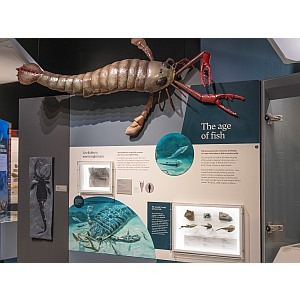
Photorealistic illustrations paint vivid pictures of ancient aquatic ecosystems alongside real and touchable replica fossils of fishes, corals, and eurypterids, a diverse group of invertebrates informally known as “sea scorpions.”
The centerpiece of the display is a life-sized model of Acutiramus, a massive eurypterid that lived in what is now upstate New York, suspended above visitors. The piece was meticulously hand-sculpted and painted by Chris Hadley, UMMNH’s exhibit and display coordinator.
“The fossil record tells us many eurypterids were formidable predators with powerful claws and large eyes, and some species were larger than humans,” said U-M Museum of Paleontology (UMMP) director Matt Friedman, who collaborated with UMMNH staff to develop the display.
When eurypterids and other large invertebrates first dominated their ecosystems, most fishes were small and restricted to specific environments. Jawed fishes were extraordinarily rare.
“Jawed fishes only became common during the Devonian ‘Age of Fishes,’ with eurypterids becoming less abundant around the same time,” said Friedman. “Some of these jawed fishes transitioned from life underwater to life on land and gave rise to the amphibians, reptiles, birds, and mammals—including humans—we know today. This early diversification of jawed fishes represents a pivotal moment in our own evolutionary history.”
The display is located on the museum’s second floor in the Evolution: Life Through Time gallery. Access to this display is included with general museum admission, which is always free to individuals and families.