This Week @NASA, May 19, 2023
- The Artemis II Moon mission crew visits D.C. …
- Another partner to land humans on the Moon …
- And preparing to get to the heart of “cosmic matter” … a few of the stories to tell you about – This Week at NASA!
Listen:
-
- mediaBrew Media Player: ( 2 Min. mp3)
- Default Device Player: ( 2 Min. mp3)
The Artemis II Crew Visits Washington, D.C.
The Artemis II astronauts were in the Washington, D.C. area May 17 through May 19 to discuss their upcoming Moon mission. NASA’s Reid Wiseman, Victor Glover, and Christina Hammock Koch, and the Canadian Space Agency’s Jeremy Hansen met with members of Congress, officials at the Canadian Embassy, and participated in other activities. Artemis II will be the first mission to fly astronauts to the Moon in more than 50 years.
Second Lunar Lander Partner Selected for Artemis
On May 19, we selected Blue Origin to develop a sustainable human landing system for the Artemis V Moon mission. The human landing system will transport astronauts to and from the lunar surface and Gateway in lunar orbit as part of NASA’s return to the Moon for science, exploration, and inspiration. The agency already is working with SpaceX to develop landers for the Artemis III and Artemis IV missions.
The Heart of Roman Space Telescope’s Primary Instrument
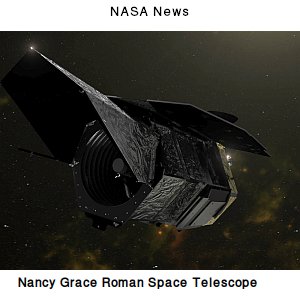
The Focal Plane System, or FPS, the heart of our Nancy Grace Roman Space Telescope, was recently delivered to Ball Aerospace in Colorado to be integrated into the telescope’s primary instrument – a giant camera called the Wide Field Instrument. Roman, which is targeted for launch by May 2027, will help unravel the secrets of dark energy and dark matter, look for exoplanets, and carry out other infrared investigations of the cosmos.
Webb Finds Water and Mystery in Rare Main Belt Comet
Researchers have used our James Webb Space Telescope to confirm water vapor around a comet in the main asteroid belt – a rare so-called main belt comet – for the first time. This finding indicates water ice from the ancient solar system can be preserved in that region of space, which is closer to the Sun than where most comets are typically located. Now, researchers will try to figure out why, unlike other comets, this one had no detectable carbon dioxide.
That’s what’s up this week @NASA … For more on these and other stories, follow us on the web at nasa.gov/twan.
- The 8th Day – Airs Sundays 6:00a - 7:00a on Marquette County's Sunny 101.9 & online http://8thday.buzz
- The show also Airs Sundays 6:00a - 7:00a on WFXD.com, Fox Sports Marquette 105.1/Gwinn 99.9, GTO.FM 97.5 FM, and WRUP 98.3
- A mediaBrew Communications Community News Partner
- Most content from State and National News is broadcast/posted unedited, without bias or favor to content
- While our show airs speeches (usually unedited), debates, bona fide news interviews or scheduled newscasts, news of local and state and national interest, or an on-the-spot news event, we still welcome alternative points of view, and we encourage those with other points-of-view to write mediaBrew Communications Llc. 3060 US 41 West, Marquette, Michigan 49855 about interviews or similar content we may have previously aired, or to report legitimate news tips.