We also made progress preparing for a flight test around the Moon …
Listen:
- mediaBrew Media Player: ( 11 Min. mp3)
- Default Device Player: ( 11 Min. mp3)
And we had a very busy year in low-Earth orbit, exploring other deep space destinations, addressing climate change here on our home planet, testing technologies for next generation aircraft, and much more. Here’s a look back at those and other things we did this year at NASA.
There were plenty of developments in 2021 with existing and future missions designed to explore our solar system and beyond.
Perseverance/Mars 2020
“Touchdown confirmed! Perseverance is safely on the surface of Mars … (applause)”—Control Room
The Perseverance rover landed on Mars in February and later collected its first rock core sample – which could be retrieved and returned to Earth by a future mission.
Ingenuity Makes Historic First Flight on Another World
While the Ingenuity helicopter, a technology demonstration on that mission, became the first aircraft to make a powered, controlled flight on another planet.
James Webb Space Telescope
We completed testing of the James Webb Space Telescope and sent it to its launch site in French Guiana.
Other missions launched: IXPE, Lucy, and DART
The wide array of science missions we sent to space included the first mission to study the polarization of X-rays, the first spacecraft to visit Jupiter’s Trojan asteroids, and our first planetary defense test mission.
Chandra Sees Evidence of Possible Planet Outside our Galaxy
Our Chandra X-ray Observatory may have detected signs of a planet crossing in front of a star outside of our Milky Way galaxy for the first time.
Parker Solar Probe’s Stunn]ing View of Venus
While our Parker Solar Probe provided surprising views of Venus during a close flyby and became the first spacecraft in history to touch the Sun – flying through and sampling the environment in the Sun’s upper atmosphere.
TESS Helps Discover Trio of Hot Worlds
And the Transiting Exoplanet Survey Satellite or TESS helped discover a trio of hot worlds larger than Earth orbiting a much younger version of our Sun.
Banner: New Leadership
Some new, but familiar faces took on leadership roles at the agency. The Biden-Harris Administration chose former senator and space shuttle payload specialist Bill Nelson, and former astronaut and space shuttle commander Pam Melroy as NASA’s newest administrator and deputy administrator, respectively.
Some of our work in 2021 reflected the Biden-Harris Administration’s commitment to addressing climate change and its effect on our home planet – something NASA is uniquely positioned to do.
New Earth System Observatory Effort
We announced our Earth System Observatory, a new set of missions to help guide efforts related to climate change, disaster mitigation, fighting forest fires, and improving real-time agricultural processes.
Launch of Landsat 9
“And liftoff. Liftoff of an Atlas V rocket and Landsat 9!”—Launch Commentator
We partnered with the U.S. Geological Survey to launch the Landsat 9 satellite built to continue the program’s 50-year track record of monitoring the planet’s changing landscapes …
VP at GSFC for First Landsat Images
Several weeks later, Vice President Kamala Harris visited the agency as we unveiled the satellite’s first images.
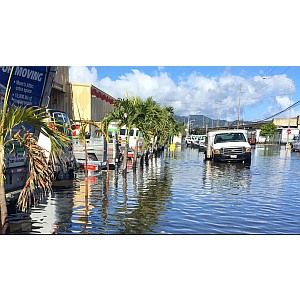
Coastal Flooding Expected Next Decade
NASA conducted and participated in a series of climate change studies related to high-tide floods, and Earth’s energy imbalance and energy budget.
Efforts to Support Global Response to Climate Change-COP22
As part of a global response to climate change, we participated in the UN Climate Change Conference (COP26).
Efforts to Support Global Response to Climate Change-ECOSTRESS
We captured data with a specialized instrument on the space station to help fight forest fires in the Western U.S.
Dashboards on Spread and Effects of COVID-19
We also coordinated with researchers to develop dashboards on the spread and effects of the COVID-19 pandemic, including tracking any changes to worldwide air pollution.
OPEN ET Data Sharing Platform
And we launched an online platform called OpenET to help farmers and water managers in 17 western U.S. states accelerate improvements and innovations in water management.
2021 was the busiest year for human spaceflight at the International Space Station in a decade. It also marked the start of the 21st straight year of humans living and working in space.
ISS Crew Rotation Flights-Crew-1
The splashdown of our SpaceX Crew-1 mission marked the completion of the first operational commercial crew flight to the station, and the first nighttime splashdown of a U.S. crewed spacecraft since Apollo 8 in 1968.
ISS Crew Rotation Flights-Crew-2
“And liftoff …”—Launch Commentator
Our SpaceX Crew-2 mission followed that. It was the first commercial crew mission to fly two international partners and spent a record 199 days in space.
ISS Crew Rotation Flights-Crew-3
And in November, NASA’s SpaceX Crew-3 mission arrived at the space station for a planned six-month scientific research mission.
Volume of Spacewalks
Astronauts and cosmonauts completed 13 spacewalks outside the space station, the most in a year since 2010.
Selection of a new class of NASA astronaut candidates
With no slowdown to human spaceflight in sight, we introduced 10 new astronaut candidates in early December.
Applications for New Flight Directors/Axiom-1 Announcement
We also accepted applications for the next class of flight directors, and announced plans for the agency’s first two private astronaut missions to the International Space Station.
Volume of Commercial Cargo Deliveries
Cargo missions flown to the space station by our commercial partners delivered more than 33,000 pounds of science, tools, and critical supplies, and returned thousands of pounds of research and equipment to Earth.
NASA Selects Companies to Develop Commercial Destinations in Space
And we signed agreements with three companies to develop early concepts of commercial destinations as part of our efforts to enable a robust, American-led commercial economy in low-Earth orbit.
We made significant progress in 2021 preparing for the Artemis I integrated flight test around the Moon next year.
SLS, Orion Prelaunch Processing for Artemis I
Engineers at our Kennedy Space Center finished installing and testing components and systems for the Orion spacecraft to make sure it is ready for Artemis I.
Meanwhile, teams at our Stennis Space Center completed the eight-part Green Run test campaign with the Space Launch System or SLS rocket’s core stage.
Activities supporting other Artemis missions
There was also work in 2021 toward future Artemis missions to the Moon with astronauts. We delivered a key piece of Artemis II flight hardware to Florida, completed the welding of another major piece of hardware for the mission, and conducted a series of water impact testing with a test version of Orion.
Partnered with SpaceX to Continue work on First Crewed Artemis Lunar Lander
We partnered with SpaceX to continue development of the first commercial human lunar lander. Through Artemis, we plan to land the first woman and first person of color on the Moon.
Power and Propulsion Element test for Gateway
Working with commercial partners, we completed the first propulsion system ground tests with the Power and Propulsion Element for Gateway. Also, Japan became the third nation to support development of the lunar outpost.
CLPS – Lunar Landing Site Selected for Artemis Rover
And the lunar landing site for our VIPER robotic rover was selected – a region just outside the western edge of Nobile Crater at the Moon’s South Pole. VIPER will be delivered to the Moon in 2023 through our Commercial Lunar Payload Services initiative or CLPS – part of Artemis.
We advanced space technology in 2021, with new concepts to help drive space exploration and benefit life on Earth.
Laser Communications Relay Demonstration (LCRD)
Our Laser Communications Relay Demonstration was launched to highlight the next era of space communications.
Nuclear Thermal Propulsion Reactor Concept Awards
We teamed with the Department of Energy to advance nuclear spacecraft propulsion technologies and fission surface power concepts to boost future space exploration.
Cutting-edge technology Perseverance/Mars 2020
An onboard suite of cutting-edge technology helped the Perseverance rover land safely on Mars, provide its first weather report, and produce oxygen on the Red Planet for the first time.
Deep Space Atomic Clock concludes mission
And our Deep Space Atomic Clock concluded a successful two-year mission to advance precise timekeeping in space.
We continued our aeronautics research efforts this year to validate unique airframe design technologies for more quiet, safe, and efficient flight on next-generation aircraft.
X-59 Quiet Supersonic Technology
We reached several milestones in assembly of our X-59 Quiet Supersonic Technology aircraft and removed the experimental plane from its external construction supports.
X-57 Maxwell All-Electric Aircraft
Meanwhile, we completed high-voltage testing on our all-electric X-57 Maxwell aircraft.
Transonic Truss-Braced Wing Aircraft
We conducted wind tunnel testing with a full-scale concept X-plane – the centerpiece of a national partnership with industry, academia, and other agencies to achieve net-zero emissions in aviation by 2050.
ATD-2: Airspace Technology Demonstration 2
We wrapped up our Airspace Technology Demonstration 2 project after six years of successful research into reducing flight delays, streamlining airport operations, and curbing emissions.
Advanced Air Mobility National Campaign
We conducted flight tests with an all-electric vertical takeoff and landing aircraft to collect data critical to our Advanced Air Mobility National Campaign.
STEReO: Scalable Traffic Management for Emergency Response Operations
And a wildfire management workshop NASA hosted demonstrated how emergency responders can fight fires more safely and effectively using NASA technology.
We launched our Mission Equity initiative in 2021, as part of a federal government effort to support historically underserved and underrepresented communities.
Named HQ to Mary W. Jackson Headquarters Building
Our headquarters building in Washington was named after Mary W. Jackson, the first African American female engineer at NASA. She was part of a group of women whose work was critical to sending the first Americans to space.
In-flight event with Deaf, Blind, Hearing and Visually Impaired
And students who are deaf, blind, hearing and visually impaired connected with astronauts aboard space station during an in-flight event to promote inclusion in space.
There were plenty of opportunities in 2021 for students to engage in NASA STEM-related activities.
Moon Pod Essay Contest
NASA collaborated with Future Engineers to create the Artemis Moon Pod Essay Contest, in which nearly 14,000 students from every state in the country participated.
Mission to Mars/Unfold the Universe Challenges
Our Mission to Mars Student Challenge demonstrated how science, math, and creativity are used to design, build, launch, and land a Mars mission.
First Woman Interactive Graphic Novel
We published “First Woman,” the agency’s first digital interactive graphic novel, in English and Spanish.
TechRise Student Challenge
Student teams designed and launched climate, remote-sensing, and space exploration experiments on suborbital rockets and high-altitude balloons.
Funding Awarded to Minority Serving Institutions
And the agency awarded funding to Minority Serving Institutions to study our home planet, develop space technology, and expand participation in science, technology, engineering, and math fields.
When all is said and done, the underlying reason we do what we do – from advancing space exploration, to making groundbreaking scientific and technical discoveries, to monitoring the health of our planet, to developing innovative modes of transportation – is to benefit you!
Those are some of the highlights from what NASA did in 2021. For more details, visit nasa.gov/2021. Thanks for watching. Please have a safe, healthy, and happy holiday season, and we look forward to sharing more NASA highlights with you in 2022!
- The 8th Day – Airs Sundays 6:00a - 7:00a on Marquette County's Sunny 101.9 & online http://8thday.buzz
- The show also Airs Sundays 6:00a - 7:00a on WFXD.com, Fox Sports Marquette 105.1/Gwinn 99.9, GTO.FM 97.5 FM, and WRUP 98.3
- A mediaBrew Communications Community News Partner
- Most content from State and National News is broadcast/posted unedited, without bias or favor to content
- While our show airs speeches (usually unedited), debates, bona fide news interviews or scheduled newscasts, news of local and state and national interest, or an on-the-spot news event, we still welcome alternative points of view, and we encourage those with other points-of-view to write mediaBrew Communications Llc. 3060 US 41 West, Marquette, Michigan 49855 about interviews or similar content we may have previously aired, or to report legitimate news tips.